Canada co-hosts the first three-nation, 48-team World Cup, and while it stages fewer matches than its giant neighbour to the south, it brings two of the tournament's most appealing venues: an intimate, lakeside, soccer-specific ground in Toronto and a domed downtown landmark in Vancouver that once hosted the Winter Olympics. Both will see the Canadian national team play its home group games.
Here is the story of each stadium — what it is, what makes it special and the host city around it.
The 2026 World Cup in brief
The 2026 FIFA World Cup, played across June and July 2026, is the biggest in history: the first with 48 teams and 104 matches, and the first co-hosted by three countries — Canada, the United States and Mexico — across 16 cities. The opening match is in Mexico City and the final near New York, at MetLife Stadium on 19 July.
Canada hosts matches at two stadiums — BMO Field in Toronto and BC Place in Vancouver — including the Canadian national team's home group games. Below is each one in detail.
BMO Field — Toronto
BMO Field opened in 2007 as Canada's first purpose-built soccer ground, planted on the Lake Ontario shore at Exhibition Place — the old fairgrounds of the Canadian National Exhibition, barely 2 km west of downtown and one of the most central venues in the whole tournament. For its early years it was a modest, single-tier home for Toronto FC; the stadium you will see in 2026 is the product of a decade of rebuilding. A roughly 120-million-dollar expansion in 2015–16 threw a sweeping canopy over the stands, added an upper deck and widened the pitch to Canadian-football dimensions so the CFL's Toronto Argonauts could move in beside the football club.
It is a ground that plays much bigger than its size. Toronto FC won the 2017 MLS Cup on this turf — the peak of one of the great seasons in league history, and sweet revenge for losing the final at home a year earlier — and the stadium has since hosted the Grey Cup and the 2017 NHL Centennial Classic, an open-air hockey game on a rink laid over the frozen field on New Year's Day. For the World Cup it has been stretched to its limit: temporary north and south stands lift the usual ~30,000 capacity to 45,736, the smallest in the tournament — and, with the crowd packed close over the touchlines, potentially its most intimate and loudest. Canada plays here on 12 June in the first men's World Cup match ever staged on Canadian soil, then returns for further group games. The TTC's 509 streetcar from Union Station and GO trains to Exhibition station drop you at the gates.
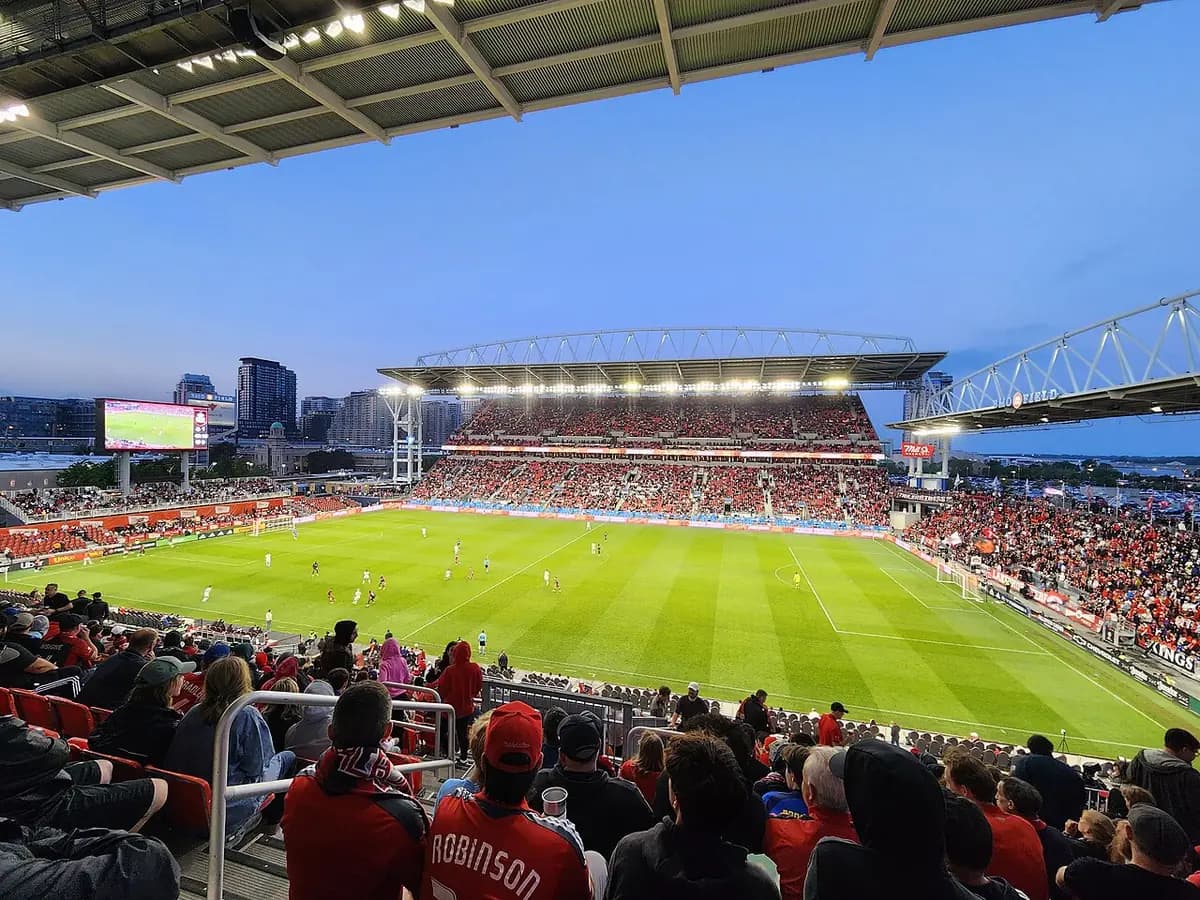
BMO Field at Exhibition Place on the Toronto lakefront — the tournament's smallest and most intimate venue.
H4stings, CC BY-SA 4.0, via Wikimedia Commons
BC Place — Vancouver
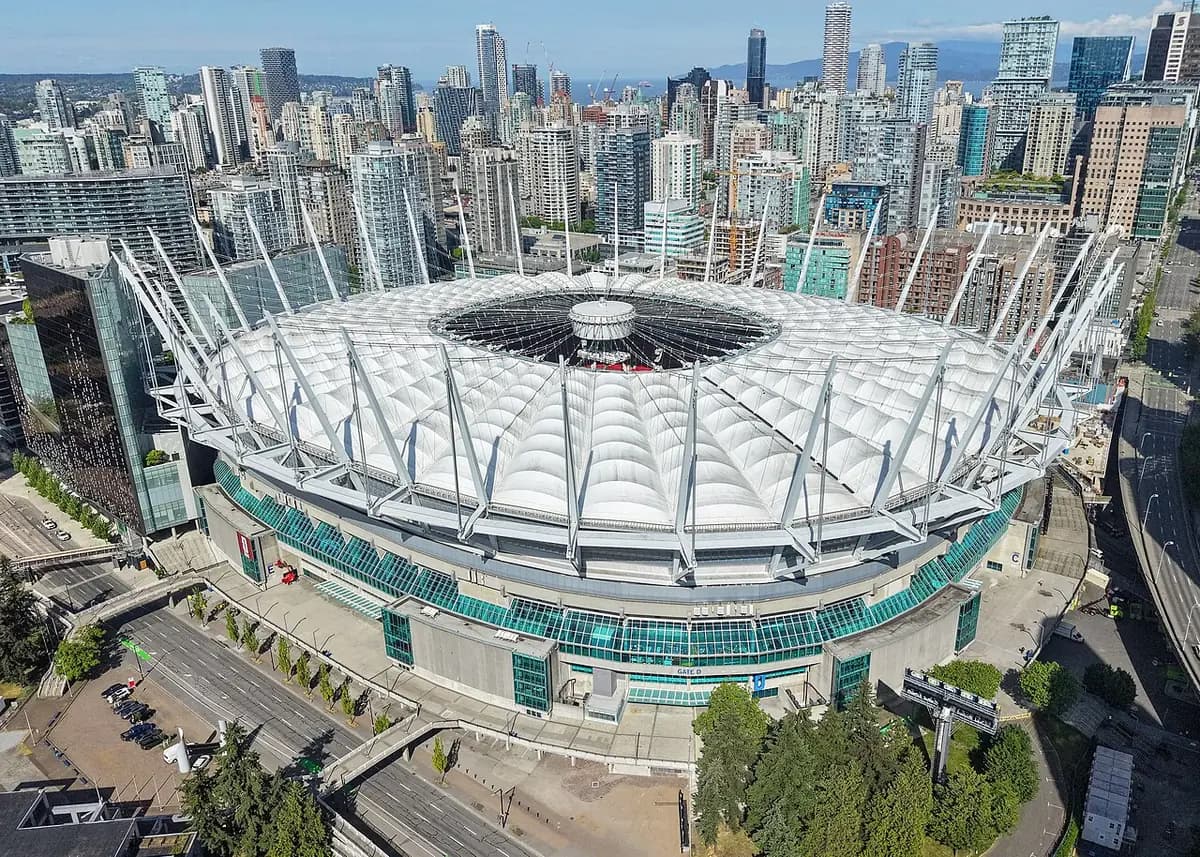
BC Place sits right in the heart of downtown Vancouver, ringed by glass towers with the North Shore mountains rising behind. When it opened in 1983 it was the largest air-supported domed stadium in the world — a billowing white roof held up by nothing but air pressure, the landmark that anchored the skyline for a generation. That roof came down for good after a dramatic deflation in 2007, when winter snow tore the fabric and the dome sagged onto the field; in its place a roughly half-billion-dollar rebuild, finished in 2011, hung a vast cable-supported retractable roof that now opens or closes in about 20 minutes, keeping matches dry whatever the Pacific Northwest throws down.
Few stadiums anywhere carry a bigger event résumé. BC Place staged the opening and closing ceremonies of the 2010 Winter Olympics and Paralympics, and in 2015 it hosted the FIFA Women's World Cup final, where the United States beat Japan 5–2 before a capacity crowd. It is home to MLS's Vancouver Whitecaps and the CFL's BC Lions, houses the BC Sports Hall of Fame beneath its stands, and faces the plaza memorial to Terry Fox. Seating about 54,000, it is Canada's larger World Cup venue, staging Canada's home group matches plus a Round of 32 and a Round of 16. The SkyTrain's Stadium–Chinatown station is right at the door, and most downtown hotels are within walking distance.
Stadiums in the USA and Mexico
Most of the tournament is staged beyond Canada. The United States hosts 11 stadiums — including the final at MetLife near New York, both semi-finals, and some of the most extravagant grounds in world sport, from the costliest ever built (SoFi) to the loudest (Arrowhead). Mexico brings three storied venues led by the Estadio Azteca in Mexico City, the only stadium to host three men's World Cups, which stages the opening match, alongside Estadio Akron in Guadalajara and Estadio BBVA in Monterrey.
For the full story of the American venues and their host cities, see our guide to the USA World Cup stadiums.
BMO Field in Toronto and BC Place in Vancouver. BMO Field is an intimate, open-air, soccer-specific ground on the Lake Ontario shore, expanded to about 45,700 for the tournament; BC Place is a larger domed stadium (about 54,000) in downtown Vancouver with a retractable roof. The Canadian national team plays its home group games at both.
Yes — BC Place in Vancouver has a vast cable-supported retractable roof, added in a 2009–2011 renovation, that opens or closes in about 20 minutes, so matches there are weatherproof. BMO Field in Toronto is open-air, on the lakefront, with no roof.
BC Place in Vancouver, at about 54,000, is the larger of the two. BMO Field in Toronto normally seats around 31,000 and has been expanded with temporary stands to 45,736 for the World Cup — still the smallest venue in the tournament, which makes for a tight, loud atmosphere.